Category: EDCI 338

CC#4: Affordances of Platforms that Support PLNs

I mostly use LinkedIn when I’m looking for a job. When I open it, the page shows me jobs, people, and companies that are close to what I already look at. I never really thought about why until this week’s reading.

Bucher and Helmond (2018) explain that affordances are about what a design makes people think they can do. They mention and talk about what the Norman’s idea that good design should make the possible actions visible to the user. But on social media, not everything is visible. Bucher and Helmond say that algorithms can act as hidden affordances, shaping what we see without us noticing the influence.

For me, recommendations are the biggest example. Bucher and Helmond also say that platforms personalize what each user sees, and that our clicks and likes feed back into the system. That means the more I engage with tech jobs and tech people, the more LinkedIn shows me the same thing. I’d guess about 80 to 90 percent of my connections are in computer science or tech, so my network already looks pretty narrow.

What does this keep out of view? People in other fields who could help me see my career in a new way. I wouldn’t even know they exist unless I went looking, because the feed doesn’t show them to me.

I haven’t tried changing this yet, but I want to.

How much control do we really have over our PLN if platforms are deciding who to recommend to us? Is this good for us, or should we be figuring out how to change this?

CC#3 Diversity and Inclusion in My PLN

Looking at my own PLN honestly, it’s just the same people. It’s almost entirely CS and ML people, classmates, developers I follow, GitHub as a whole. I guess that it’s just easier to build a network around people who already think the way you do. But I think easier doesn’t mean better, though.

The clearest example of this actually mattering was during my co-op at the National Research Council. I was building an ML pipeline for retrieving astronomical images, a technical problem from where I sat. But the people actually using it were astronomers, and the questions and the functionality they wanted and cared about were completely different from mine. I was aiming for the retrieval accuracy and speed. They cared about whether the tool actually fit their research workflow, and what a false positive actually cost them in wasted hours. I hadn’t built the wrong thing, but I’d been solving a narrower version of the problem than the one that actually existed, and that gap only became visible because people outside my field were in the room.

That is close to what Margaret Heffernan’s TED Talk, “Dare to Disagree”, is about, where she describes a researcher who deliberately worked with someone who actively challenged her conclusions, and how that friction led to a real breakthrough rather than slowing her down. Having a diverse PLN and having an inclusive one aren’t the same thing. I could follow people from completely different fields and still never learn anything from them if I don’t actually engage with what they’re saying, or if nobody in my network is actually willing to push back or give me a different perspective on how I think.

Right now my PLN is comfortable, mostly people who already validate the way I think about problems. That’s exactly the setup that could let me miss something obvious, the way I almost did on that co-op project.

I have a question for anyone who has actually diversified their PLN on purpose: what did that look like to you- direct conversations, working on something together, or something else, Excited to hear?

Mapping My Digital Identity, CC#2

Sneh Duggal

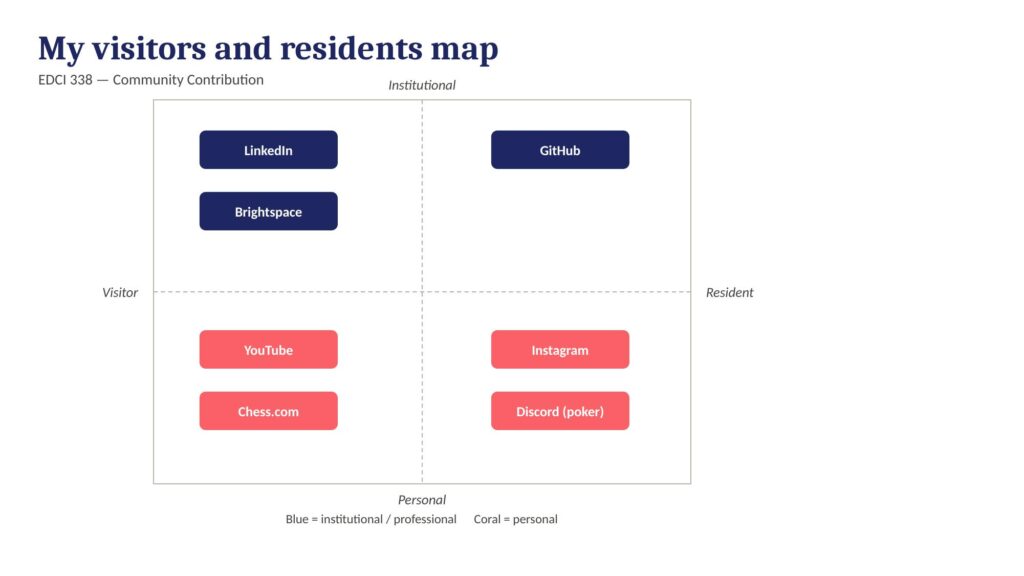
Making this map was a good excuse to actually think about how I use each platform.

LinkedIn and Brightspace both landed institutional-visitor. I use both because school or the career stuff requires it, but I’m not really building a presence on either one so I check in, do what I need, and leave. GitHub is the one platform where I’m actually institutional-resident. It’s not just a place I visit for a task, it’s the current record of what I’ve built, and other people can look through it the same way I look through other students’ or researchers’ repos. That’s the closest thing I have to an active professional network right now.

On the personal side, YouTube and Chess.com are visitor platforms for me; I use them constantly, but almost entirely to consume- ML tutorials, chess puzzles, whatever- without any presence of my own there. Instagram and my poker group chat on Discord are where I’m actually a resident, that’s where people know me, where I’m participating.

That actually makes me a little more aware of the LinkedIn gap. It’s the one platform meant to build a professional network, and I’m currently just visiting it, not participating in it. If I want it to actually function as part of my PLN instead of just an online resume, I’d need to start acting more like a resident there, engaging with posts, following people in ML and AI, and the other influencers in this space not just keeping a profile up to date; this can eventually help me land something in the future.

My question for the group: for the platform you use the least intentionally, is that because it doesn’t fit how you like to build a network, or just because you haven’t gotten around to using it that way yet? I’m not sure which one it is for me with LinkedIn.

Digital identity

Sneh Duggal

Digital Identity: The CS Student Behind the LinkedIn Profile

When I think about my digital identity, I see a professional side, LinkedIn and GitHub, and a personal side, everything else. On LinkedIn, I’m careful and very professional, for example a co-op experience at the National Research Council of Canada, or research work I did in one of the labs at UVic, projects I’ve built. GitHub is honestly the more interesting one to me, because it’s not really a resume; it’s the evidence for your resume. Anyone can say they know machine learning, but a repo with actual commits and working code says it in a way a bullet point can’t.

My personal accounts are a completely different story. That’s where you’d find me talking about badminton, jiu-jitsu, the fact that I placed top 3 at a UVic poker tournament, or clips of me playing piano at a talent show years ago. None of that is written to impress anyone. It’s just what I’m actually doing with my time outside of school.

The interesting part is that these two versions of me aren’t as separate as I’d like to believe. danah boyd’s idea of context collapse describes this well. For example, I post something for one audience (friends, a poker group chat, my badminton club) with zero thought about who else might eventually see it. But a future employer scrolling through isn’t going to read a poker result the way my friends do; they might read it as a signal about risk tolerance, or just be curious, or not care at all. I don’t get to choose which interpretation lands. That’s the part of digital identity that feels less like something I control and more like something that happens to me after the fact.

This connects to how I think about my personal learning network too. Right now my PLN is mostly informal: classmates I actually talk to about assignments, a couple of people I follow because they post real technical breakdowns instead of surface-level content, and GitHub itself functions like a network since I can see what other students and researchers are actually building. I haven’t been very intentional about it; it’s grown more by accident than by design, which is probably true of my digital identity in general. I’ve been more focused on what I put out.

So my question for the other is this: for those of you who also have a “technical evidence” platform like GitHub, a portfolio, or something similar, do you think of that as part of your professional identity, your PLN, or both?

Flight Path

Flight Path: Social Media and Personalized Learning

I’m coming into EDCI 338 from a pretty different starting point than most people in this course. I’m a fourth-year computer science student at UVic, and most of my background is on the technical side for example, machine learning, building software, doing research work rather than studying education directly. So when I think about “personalized learning,” my thinking is about it the way I’d think about a recommendation system or an adaptive algorithm, something that adjusts to a person’s inputs and gets better over time. I don’t have a background in pedagogy or teaching, but I do have a lot of experience with how technical systems shape what information reaches someone and when.

My relationship with social media is mostly personal. I use it the way most people my age do, which is like to keep up with people, follow things I’m interested in, and occasionally get sucked into something I didn’t mean to spend an hour on. I haven’t really used social media as a learning tool before. That’s actually part of why I signed up for this course. I wanted to see personalized learning and digital literacy from the other side, as something you can study and design intentionally, instead of something that just happens to you while you’re scrolling.

What I want to get out of this course is less about a specific final project and more about a shift in how I think. I want to walk away actually able to build a personal learning network on purpose. I’m also interested in the privacy and data ownership side of things- Creative Commons, copyright, fair dealing- because that overlaps with questions I already think about from the tech side, just from a different viewing point. If there’s a specific thing I’d want to explore, it’s probably something around how AI-adjacent tools intersect with personalized learning, since that’s the space I already spend most of my time in.

The part of this course that looks the most scary to me is the “recognize the internet is not a neutral space” objective. My default lens on technology is usually functional: does it work, is it efficient, rather than critical: who does this actually serve and who does it leave out. I expect that shift in thinking will be the real challenge here, more than any specific technical skill. My plan for navigating the course is to mostly stay true about where my blind spots are instead of assuming my technical background makes me think that I am very qualified to skip that reflection, and to actually engage with the weekly discussions instead of treating them as just an assignment.

Thank you

Sneh